


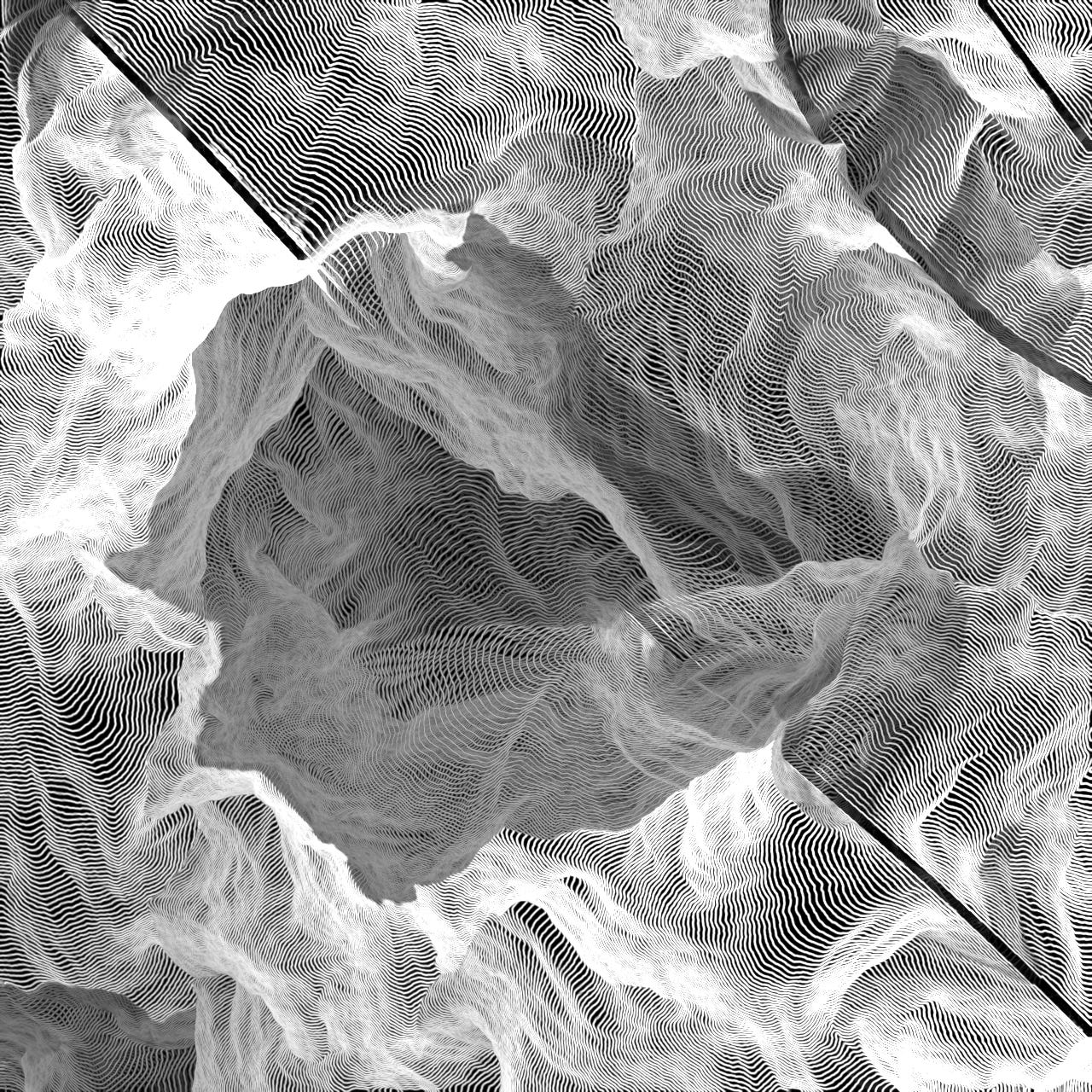
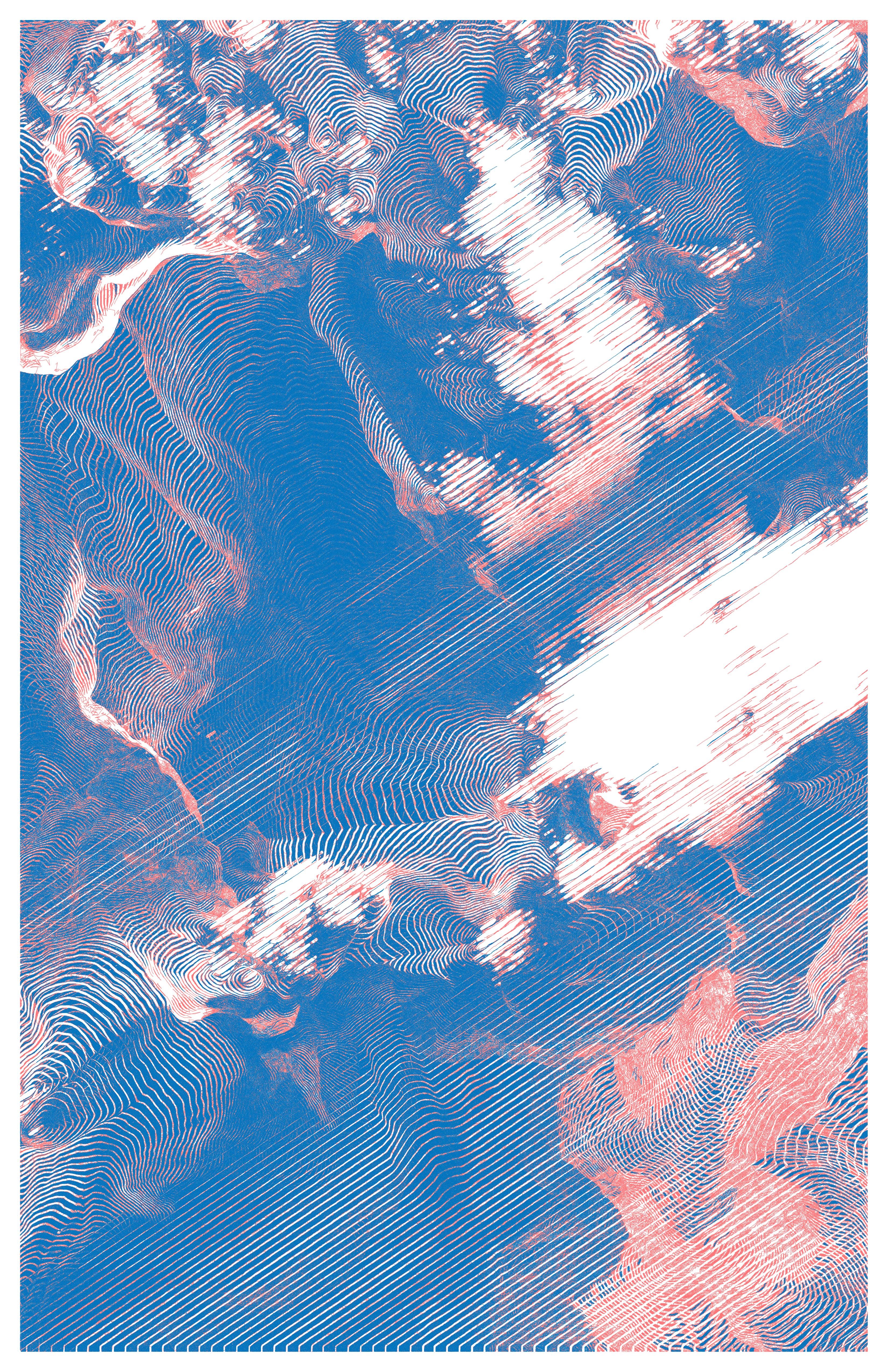
This is the story of how I translate emergent digital processes into physical artifacts. What you’re looking at isn’t a topographical map of some mountain range - it’s the ghost trail of digital particles wandering through nested feedback loops until they carve their own landscape into existence. From TouchDesigner feedback loops to plotted landscapes that never existed.
I. The Two-Loop Architecture
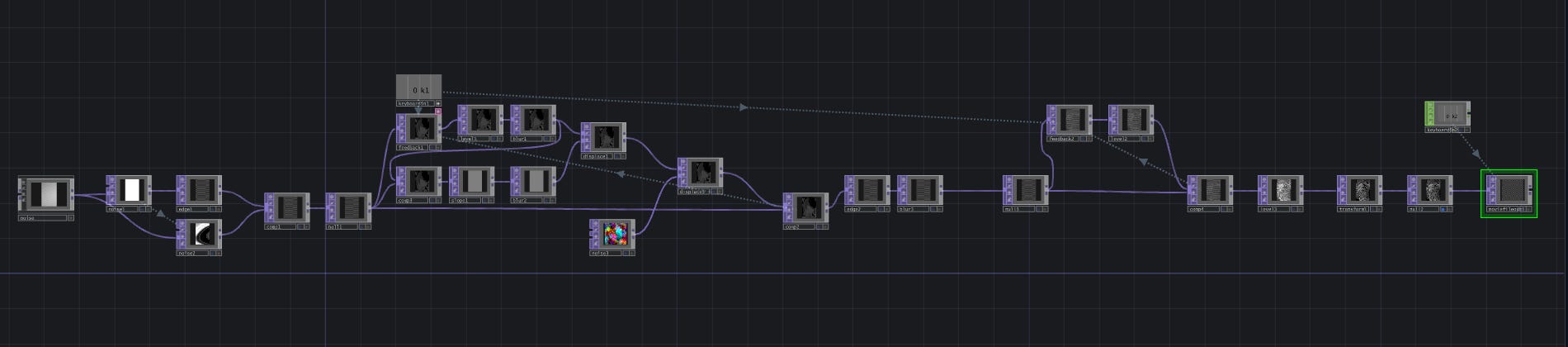
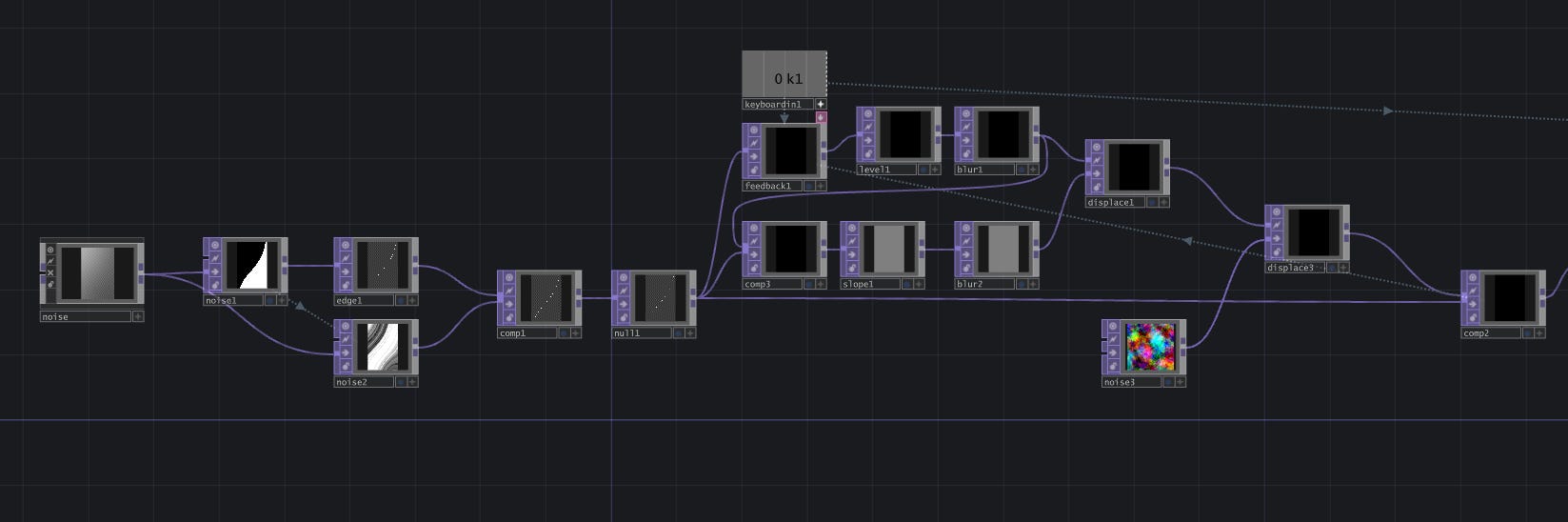
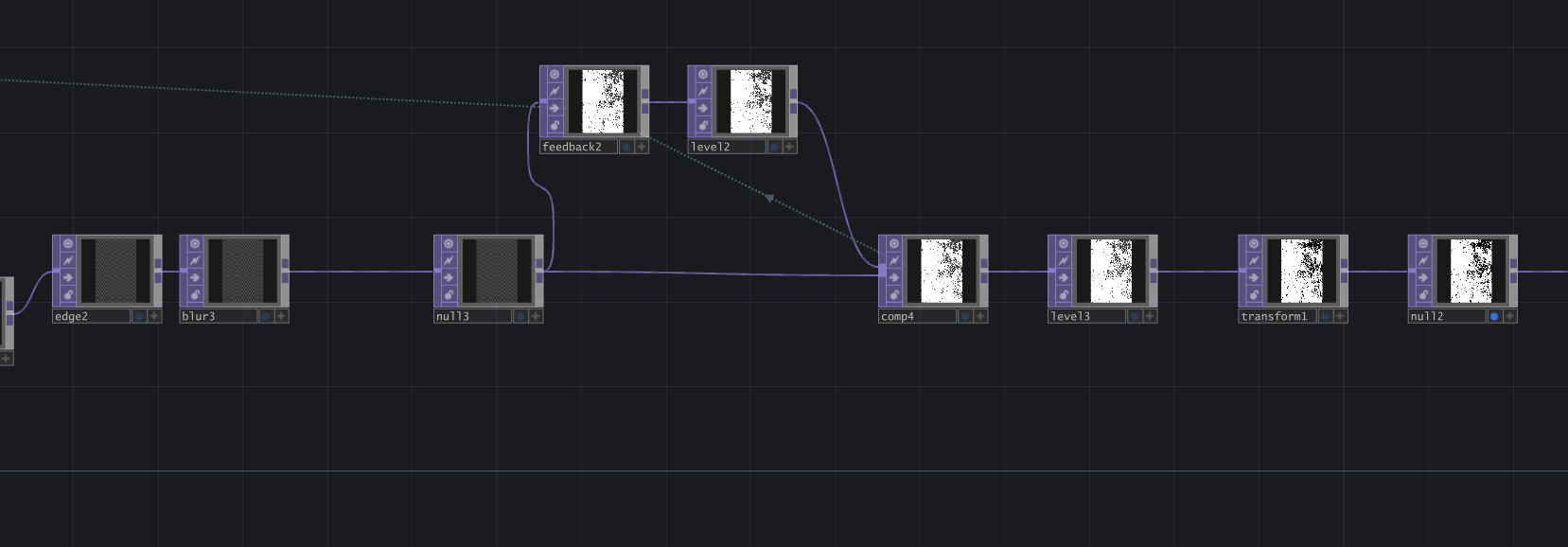
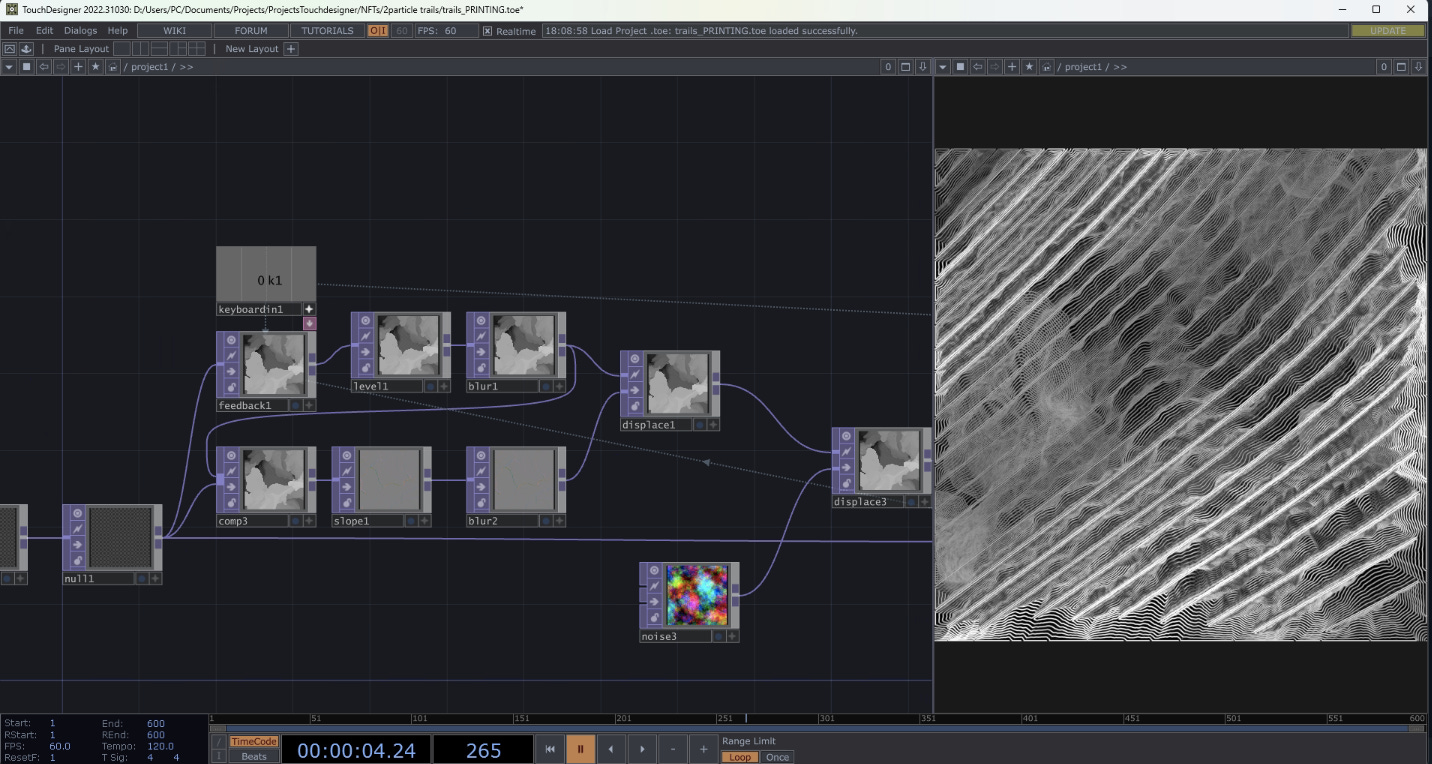
The magic happens through two nested feedback loops working in harmony to create convincing landscape illusions.
Feedback Watching Feedback
The first loop starts with animated noise, extracts its edges, and uses feedback to build up trails over time - like a long exposure of moving light sources. The second loop watches this evolution, detects the edges of those accumulated trails, and feeds them into its own feedback system to create persistent line networks.
It’s feedback watching feedback. The first creates organic flowing forms that cluster and separate like watersheds. The second traces these formations, creating line networks that follow the “ridges” and “valleys” of the evolving patterns.
Why It Works
The nested structure is crucial - without the second loop tracking the first, you just get flowing organic shapes. Without the first loop creating coherent trails, the second has nothing meaningful to track. Together, they create the illusion of contour lines mapping elevation changes across a landscape that exists only in mathematics.
II. The Emergence Begins
Something shifts. The trails begin to find each other, clustering into formations that start to suggest natural forms. Flowing lines converge and separate like water finding its path down a hillside. The second feedback loop kicks in, tracking these emerging structures and beginning to trace their evolution.
The Moment of Recognition
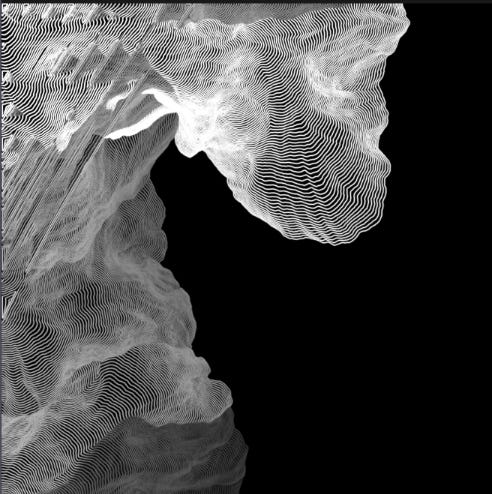
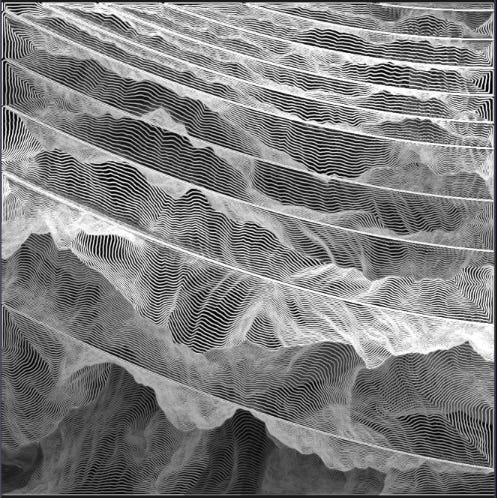
There’s always a specific moment when the illusion clicks into place. What was abstract suddenly reads as topographical. The clustered trails create dense areas that feel like valleys, while the sparse regions suggest ridgelines. The tracking lines from the second loop start forming networks that genuinely look like contour maps.
It’s not that I’m imposing this interpretation - the patterns genuinely exhibit the organizational logic of landscapes. Water flows, elevation changes, geological processes - all these natural phenomena follow similar mathematical rules to what’s happening in my feedback systems. The algorithm isn’t trying to mimic nature, but it ends up following similar patterns because the underlying dynamics are related.
Evolution in Real-Time
Once the topographical quality emerges, the patterns continue evolving. New valleys form, ridges shift and merge, entire mountain ranges appear and disappear. Sometimes the system generates incredibly detailed formations with intricate drainage networks. Other times it creates broader, more geometric structures that feel almost architectural.

III. Watching for the Right Moment
As I’m sitting at my desk, watching the screen, the patterns are evolving in real-time, and I’m reading their development. Too sparse... getting interesting... almost there...
Reading the Evolution
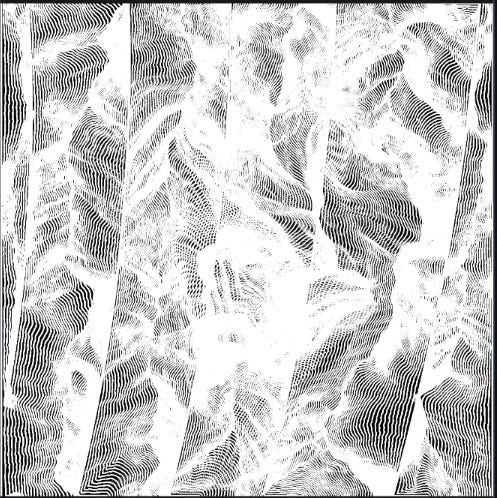
There’s a visual language to recognize. Early on, the patterns are thin and disconnected - interesting but not substantial enough to capture. As they develop, complexity builds, but there’s a critical threshold where “complex” becomes “busy.” Too many overlapping lines, too much density, and the topographical illusion breaks down into visual noise.
I’m looking for that sweet spot where the patterns have enough detail to be compelling but maintain clarity. The valleys and ridges need to read clearly. The line networks should suggest elevation changes without becoming overwhelming. It’s a balance between information and legibility.
The Right Moment
When it happens, I know immediately. Something about the composition just clicks - the patterns hit that perfect balance, and I go “It.” Not overthought, just felt. The landscape feels complete, convincing, like it could be a real place.
Sometimes I’ll adjust parameters on the fly - tweaking the noise characteristics or feedback strength to guide the evolution. But mostly I’m watching for that moment when the emergence reaches its peak before crossing into chaos.
The Reset Decision
If patterns evolve past that moment, or if they’re heading in an uninteresting direction, I hit reset and start over. There’s no point forcing a mediocre result when the system is capable of generating something genuinely compelling. The reset button becomes part of the process - knowing when to let go and begin again.
The whole process from start to capture usually takes anywhere from a few seconds to a minute or so, depending on how quickly the patterns find their rhythm.
What’s Next
This is where the digital story ends and the physical journey begins. In Part 2, I’ll walk through the translation pipeline that transforms these ephemeral screen moments into tangible artifacts - from AI upscaling through pen plotting and risograph printing. The challenge isn’t just technical; it’s preserving that essential moment of recognition through every step of the transformation.
This technique was originally learned from Pppanik’s generative topography tutorial here.
Love this. Really beautiful pieces here.
"..., complexity builds, but there’s a critical threshold where “complex” becomes “busy.”" That fine tuned zone is really at the core of everything.
Is it easy to explain how you get these generated trails to be self-avoiding?
The artwork is so beautiful!
Also, I love the way you laid this post out. Def going to be using it as a reference when I discuss my TOX’S!